

Do trial reels actually work? Why they get fewer views than your normal reels


The Junibloom team
Building the growth OS for growing creators
Your trial reel got a fraction of what your normal reels get, and you're starting to wonder if trials work at all. They can, but not against your normal reels. A trial is shown only to people who don't follow you, so it starts without the audience that gives a normal reel its first views. Instagram's head, Adam Mosseri, put the fix in writing: "The best way to know how a trial reel is doing is to compare it to other trial reels." Meta has measured them too: after trying trial reels, 40% of creators posted reels more often, and 80% of those reached more non-followers.
The short version:
- Fewer views is how trials are built. Instagram's help page says "your followers won't see it in feed or Reels," so a trial starts with people who don't follow you, and trials "may take longer to get views" for that reason.
- Compare a trial with your other trials. That's Mosseri's advice, in his own written words.
- Judge it on what strangers did with it: average watch time, likes and sends per account reached, and the Follows line.
- Instagram's trial page doesn't say a new trial takes views from an old one. It does say trials "don't impact the performance or ranking of your standard reels content."
- Meta's own result is real but narrow: 80% of the 40% who started posting more, over one month, and "performance is not guaranteed."
Why a trial gets fewer views than your normal reels 👥
A normal reel is in front of your followers the moment you post it. Mosseri calls them "normal reels that are shown to followers from the beginning." It can also reach people who don't follow you: Instagram said in April 2024 that eligible content "is shown to a small audience that we think will enjoy it, regardless of whether they follow the account that posted it or not."
A trial starts with only that second audience. Your followers won't see it in feed or Reels, and it stays off your profile "unless you decide to share them to everyone."
| A normal reel | A trial reel | |
|---|---|---|
| Your followers' feed and Reels | From the moment you post | Not until you share it to everyone |
| People who don't follow you | When Instagram recommends it | Its first audience |
| Your profile | Yes | Only once you share it |
| Compare it with | Your other normal reels | Your other trials |
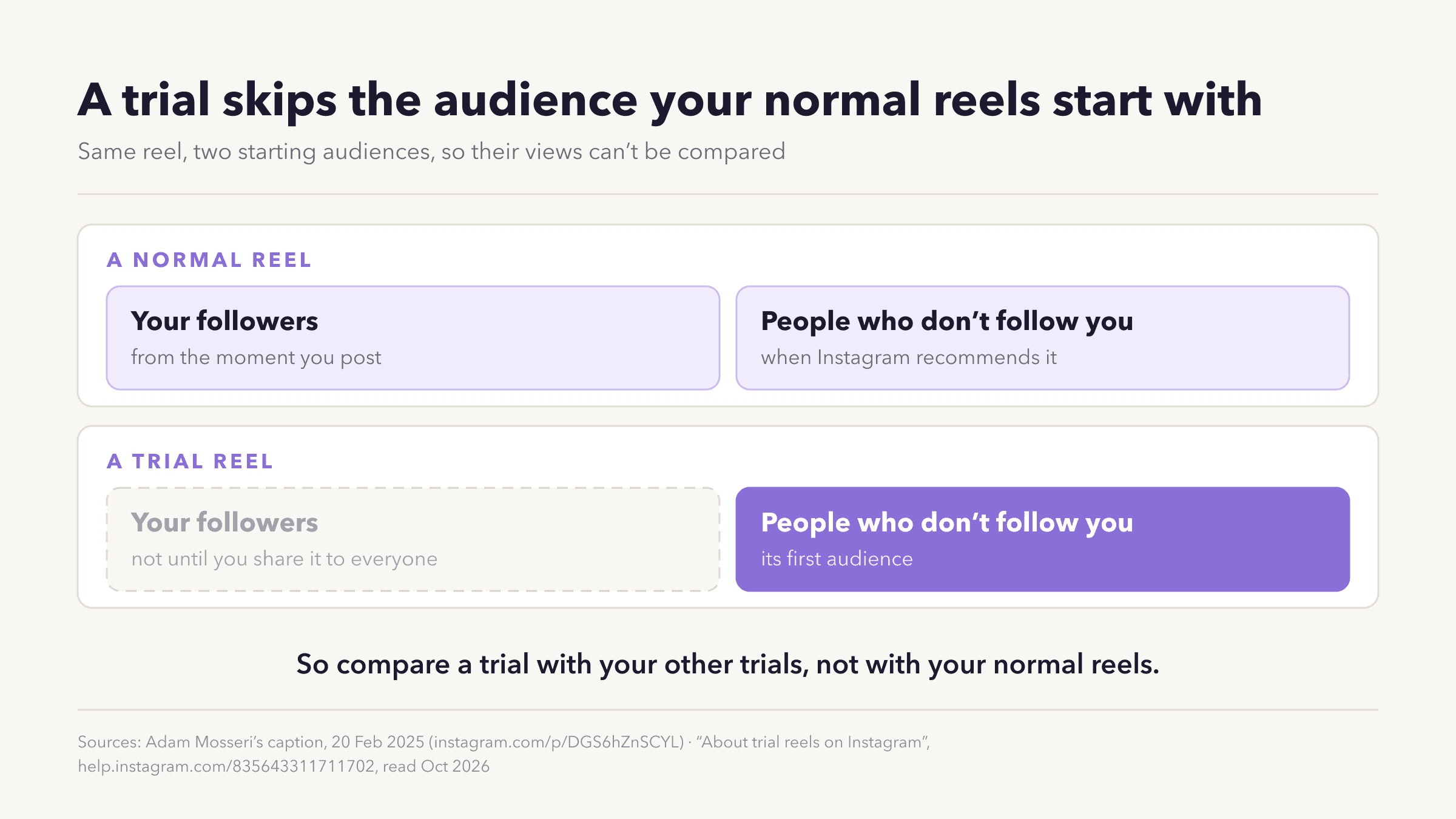
So a trial with a fraction of your usual views hasn't lost to your normal reels. It was shown to a different audience. Mosseri's caption, from February 2025, says it in full: "Trial reels won't perform like normal reels that are shown to followers from the beginning, so comparing them against each other over time will help you understand what performs well."
How to compare a trial with your other trials 📊
What to compare comes from Mosseri too. In January 2025 he wrote that "the top three signals that matter most for ranking are watch time, likes and sends," and told creators to "pay close attention to average watch time, likes per reach, and sends per reach." The same caption adds one line that matters for trials: "likes are slightly more important for connected content, and sends are slightly more important for unconnected content." A trial goes to people who don't follow you, and for them it is unconnected content.
| Write down for each trial | Why it's on the list |
|---|---|
| Average watch time | One of the three signals Mosseri named |
| Likes per reach | Likes divided by the accounts that saw it |
| Sends per reach | Mosseri: "sends are slightly more important for unconnected content" |
| Follows | Instagram counts "how many accounts started following you as a result of viewing your reel" |
Keep those four numbers for every trial in one place, and judge a new trial against the middle of your earlier ones, not against your best. Give each one a day first: Instagram says a trial's insights arrive "within 24 hours after sharing."
A trial that gets nothing at all is a different problem with its own fixes. Trial reels stuck at 0 views goes through the three causes Instagram names.
Do trial reels actually work? What Meta measured 📈
Meta has published one measurement. In June 2025 Mosseri wrote on Meta's newsroom: "after trying trial reels, 40% of creators started posting reels more often and of those who did, 80% saw an increase in reels reach from non-followers." The note under the post says it comes from "an internal analysis of over 400,000 creators actively producing reels," comparing the month after they first used trial reels with the month before, and that "performance is not guaranteed."
Read it for what it says, and for what it leaves out:
| What the number says | What it doesn't say |
|---|---|
| 80% of creators who started posting more saw their reels reach more non-followers | How much it went up |
| Those creators were 40% of everyone who tried trials, so the 80% is about a third of the total | What happened to the other 60% |
| One month after first use, against the month before | Any split by account size |
It's also Meta grading its own feature, and the note says it "controls for confounding factors" without naming them. Treat it as a result about creators on average, not a promise about your next reel.
A trial did badly. Should you still post it? 🤔
A trial's result tells you what people who don't follow you did with it. Your followers never saw it, so it hasn't been tested on them, and whether they see it is your call.
If it did fine on TikTok or YouTube, you can still post it on Instagram. Mosseri, in August 2026: "You can make videos wherever you want, and it won't hurt your reach. The one thing to avoid is wordmarks from other apps." Upload the clean file, not an export with another app's logo on it.
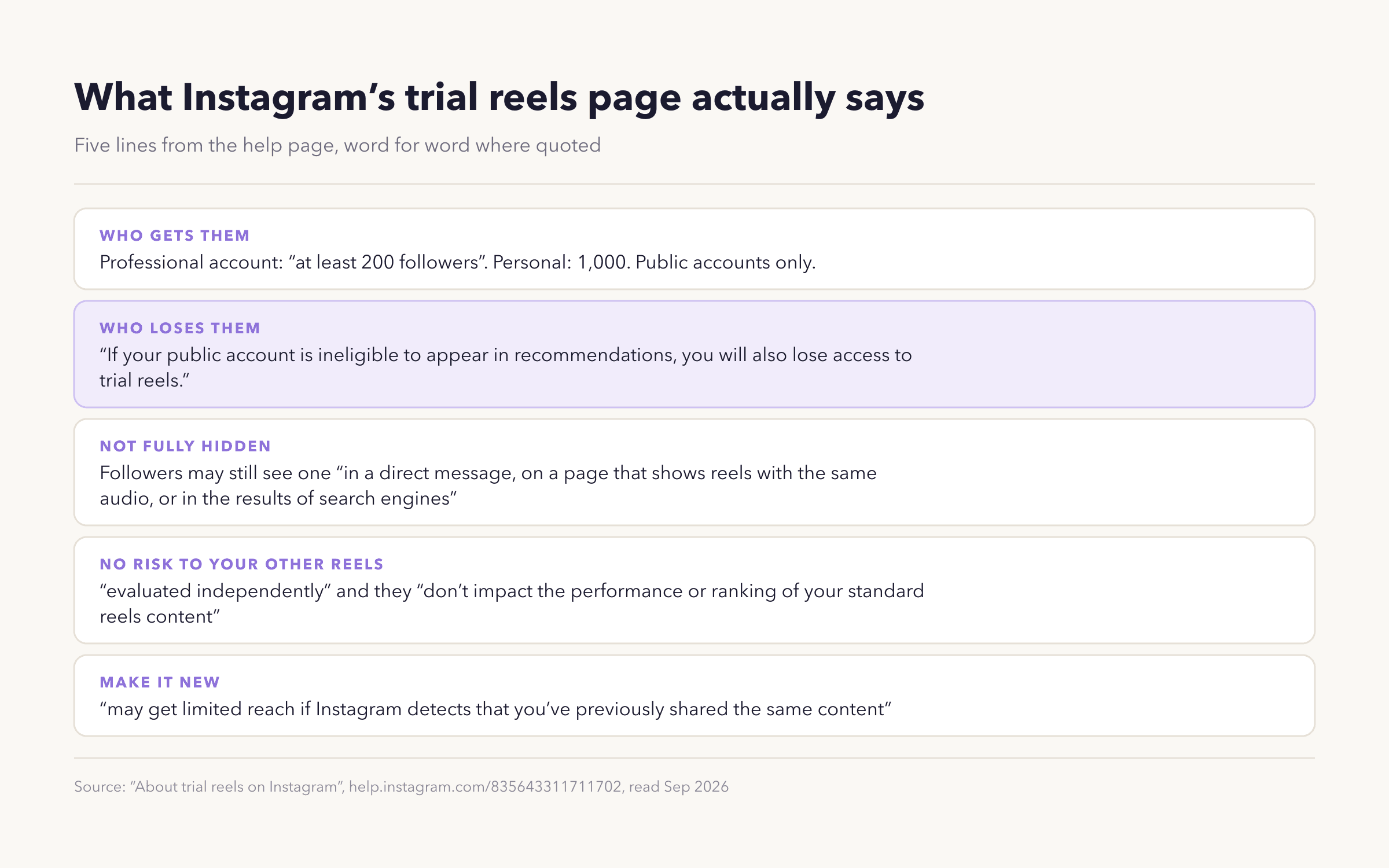
What to avoid is deleting the trial and uploading the same video as a new trial. The help page warns that a trial "may get limited reach if Instagram detects that you've previously shared the same content." If you want your followers to see it, share the trial itself, and what Share to everyone does next walks through what changes when you do. If you want to know why strangers passed on it, start with the reel's own numbers: what to check when a reel flops.
❓ Questions people actually ask
Do trial reels actually work? They do the job they're built for: showing a reel to people who don't follow you before your followers see it. In Meta's June 2025 analysis, 40% of creators started posting reels more often after trying them, and 80% of those saw more reach from non-followers. Judge yours against your other trials.
Why do my trial reels get fewer views than my normal reels? Because they skip your followers. Instagram's help page says "your followers won't see it in feed or Reels," so a trial starts with people who don't follow you, and trials "may take longer to get views because they're being shown to people who don't follow you."
Does posting a new trial reel stop the last one from getting views? Instagram's trial page doesn't say so. It says trials are "evaluated independently in Instagram's ranking" and don't affect your standard reels, and it says nothing about one trial affecting another. What it does warn about is repeating yourself: a trial of content you've already shared "may get limited reach."
Do trial reels hurt your account? Instagram says they "don't impact the performance or ranking of your standard reels content." What takes trials away is an account Instagram won't recommend: "If your public account is ineligible to appear in recommendations, you will also lose access to trial reels."
Are trial reels worth it for a small account? You need a public account with at least 200 followers on a professional account, or 1,000 on a personal one. Meta's analysis covered over 400,000 creators, and its note gives no breakdown by account size.
How long should I wait before judging a trial reel? At least a day. Instagram says you'll see a trial's insights "within 24 hours after sharing," and Meta's developer documentation says metrics data "can be delayed up to 48 hours."
Keep the record while you test
Meta's test compared a creator's reach from non-followers in the month after they started trials with the month before. You can run the same test on your own account, as long as you have the month before. Junibloom takes a daily snapshot of your reach through Instagram's official API and keeps the follower half and the non-follower half apart, so the weeks you spent on trials show up as a line rather than a hunch. You connect through Instagram's own login on instagram.com, it only reads, and you can disconnect any time. It needs a professional account, which is free to switch to and is the account type that gets trials at 200 followers instead of 1,000.
Whether the follows from your trials add up to real growth is the next question, and what counts as a good growth rate at your size has the two published benchmarks and why they disagree.