

Your Instagram posts are in Google. Now you can see the search terms.


The Junibloom team
Building the growth OS for growing creators
Short answer: you can now see the Google search terms that lead people to your Instagram posts, for free, with no website involved. Google added Instagram as a property type in Search Console on July 7 2026 (Google Search Central blog) and posted the global rollout later the same month. Connect the account, wait a few days, and you get queries, clicks, impressions, click-through rate and average position for your public posts.
Second answer, the one nobody is giving you: those clicks are not Instagram reach, and they do not belong in your media kit as if they were. What they are is the first honest look at the words your audience types into a search box before they find you.
This is two changes, a year apart
People keep merging them into one story. They are separate, and the gap between them is the interesting part.
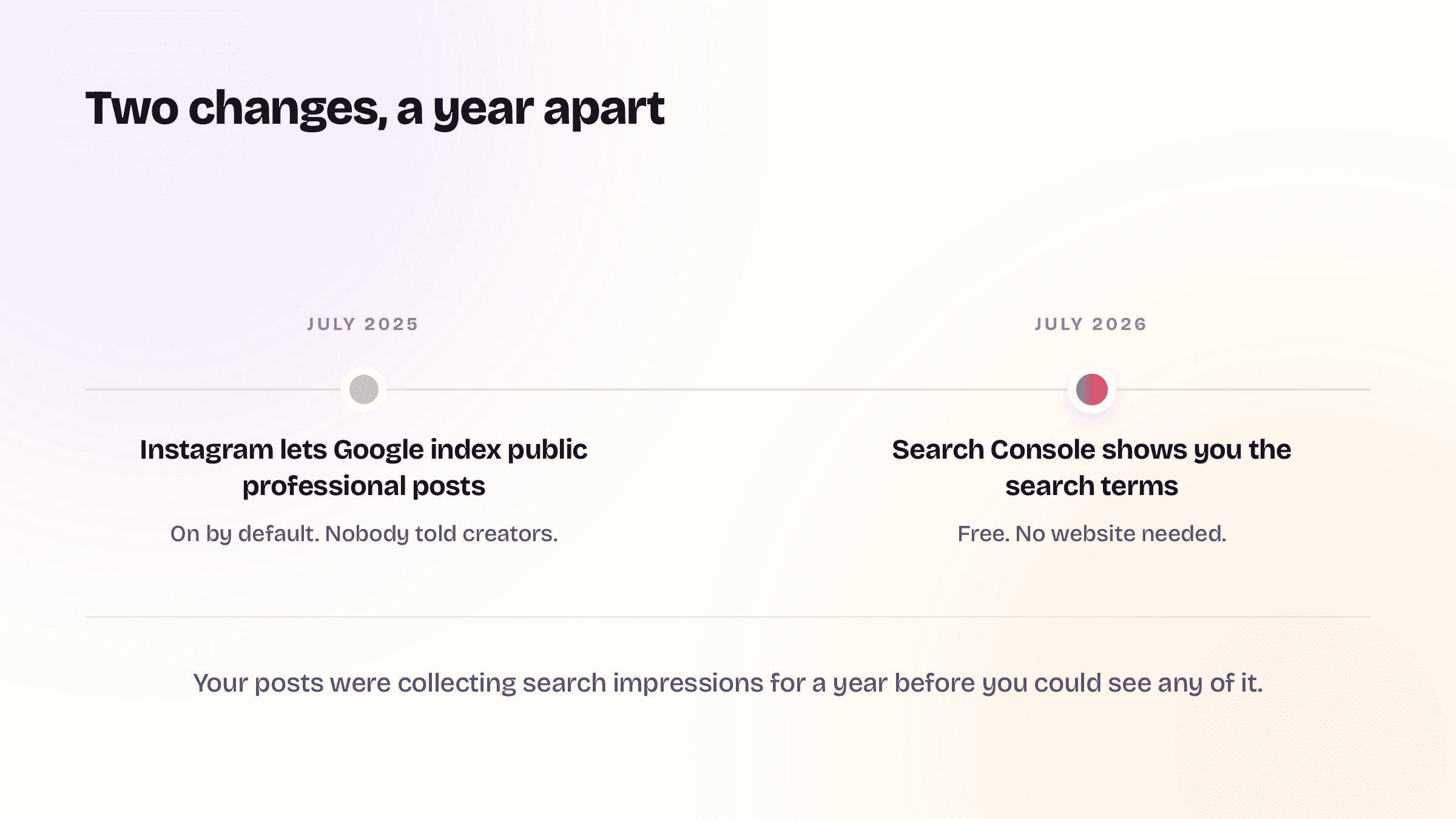
July 10 2025. Instagram let Google and Bing index public posts from professional accounts, business or creator, for account holders aged 18 and over. Only posts published on or after January 1 2020 qualify. Stories, Highlights, private accounts and personal accounts are not indexed. It is on by default. The off switch sits in Settings, under Privacy, as "Allow public photos and videos to appear in search engine results."
July 7 2026. Google handed over the data. Search Console added platform properties for Instagram, TikTok, X and YouTube, announced on the Search Central blog by the Search Console product manager lead, rolling out gradually over several weeks and then globally.
So your posts have been quietly collecting search impressions for about a year. Nothing changed about your content this month. What changed is that you can finally see it.
What the reports actually give you
Three of them.
Performance. Total clicks, impressions, average click-through rate and average position, filterable and sortable by query, by post, by country and by date. This is the one worth opening.
Insights. Recent traffic trends, your top-performing posts, and how people are finding your account.
Achievements. Click milestones measured over 28-day periods.
The default date range is 28 days. A new property needs a few days before it shows anything, so an empty dashboard on day one is normal rather than broken. Coverage spans Google Search, Discover and Google News where it applies. Google also rechecks ownership periodically, so leave the connection in place once you make it.
The number that is not your reach
Your posts now land on three surfaces that count in three different ways.
Followers see you in feed. Instagram discovery puts you in Reels, Explore and in-app search. Google sends people in from outside the app entirely. Only the first two show up in your Instagram insights, and none of your insights tell you which query brought someone in. That is precisely the hole Search Console fills.
If you have already split your reach into follower reach and discovery, which is the only reliable way to diagnose a drop, add a third line to that split. Flat reach plus rising Google clicks is not a problem with your account. It is an audience arriving through a door Instagram never showed you.
What to claim in a pitch, and what to leave out
Leave the impressions out. An impression in Search Console means your post appeared somewhere on a results page. It is not a view, it is not reach, and any brand that cross-checks it against the numbers Instagram reports will catch the mismatch. One inflated number is enough to make a brand distrust the whole document.
Use the query list instead. Audience fit is the first thing a brand screens for, ahead of size, and most of what creators put on a media kit is not what gets checked. A list of the exact phrases people search before they land on your posts is evidence of a niche in a way a follower count never is. "My audience is women aged 25 to 34 who care about skincare" is a claim about yourself. "These are the twelve search terms that bring people to my posts" is a receipt.
The caption trade-off nobody is naming
Here is where the SEO advice currently being aimed at creators goes wrong.
Google reads captions, usernames, bios and hashtags. So the obvious move is to load the caption with search phrases. Do not do this. The first line of your caption is doing a far more valuable job inside Instagram, where watch time and sends decide whether the post gets distributed at all. A caption rewritten for a search engine opens with a keyword instead of a hook, and you trade a large immediate audience for a small slow one.
The version that works: hook in line one, plain description in the last two lines, after the post has already earned its distribution. And write the phrase a human would actually type. "Cheap high protein breakfast, no cooking" is a query. "Fuel your morning" is not a query, it is a slogan.
What to do this week
- Check the indexing toggle in Settings, then Privacy. On means Google can see you.
- In Search Console, open the property selector, choose Add property, pick Instagram, and authorise the connection. No domain, no code. If Instagram is not offered yet, it is the gradual rollout, not you.
- Wait about a week, then open Performance and sort by query rather than by clicks.
- Read the query list as content research first and as a traffic report second. Every phrase there is a post somebody already wanted.
- Export or screenshot the list once a month, because the window is short and moving.
Do not overrate this
For an account between 10k and 100k followers, Google is very unlikely to become a growth channel. Search demand for a specific creator's posts is thin unless you make things people look up on purpose: recipes, routes, prices, product comparisons, how-to. Treat this as a research feed with a small trickle of clicks attached. Anyone telling a micro-creator to rebuild their content calendar around Google is selling a service.
The genuinely useful part is the vocabulary. You now know, with data rather than a guess, which of your topics people go looking for.
One catch worth flagging. The Search Console window opens on the day you connect and defaults to the last 28 days. The year your posts spent being indexed before that is simply not there. That is the same shape of problem creators hit on the Instagram side, where the numbers a brand asks for are the ones from months back and the app's own history was never built to hold them for you. Junibloom takes a daily snapshot of your Instagram numbers so that history exists when somebody asks, and turns it into a media kit and a rate you can actually defend.